Introduction
Solar mounting systems on agricultural land require careful planning to balance solar energy production, land use, and agricultural activities. From ground conditions to structural stability, several factors influence the design and performance of agricultural solar mounting structures.
Understanding these considerations helps project developers select suitable solar mounting solutions for farmland and agrivoltaic projects.
1. Land Conditions and Soil Properties
Soil conditions directly affect the foundation design and stability of ground-mounted solar systems. Soil bearing capacity, composition, drainage, and groundwater levels should be evaluated before selecting foundation types.
Depending on site conditions, ground screws or concrete foundations may be considered. Proper foundation selection helps ensure reliable structural support and long-term system stability.
2. Solar Mounting Structure Height and Clearance
For agricultural solar projects, mounting height and ground clearance are important design factors. Sufficient clearance can provide space for agricultural machinery, livestock movement, and crop cultivation beneath or between solar panel rows.
The required structure height depends on the intended agricultural activities, equipment dimensions, and solar panel arrangement. Appropriate clearance helps improve land usability while maintaining structural safety.
3. Structural Strength and Wind Resistance
Solar mounting systems on agricultural land must withstand environmental loads, including wind, snow, and temperature variations. Structural design should consider local climate conditions, applicable building codes, and project-specific engineering requirements.
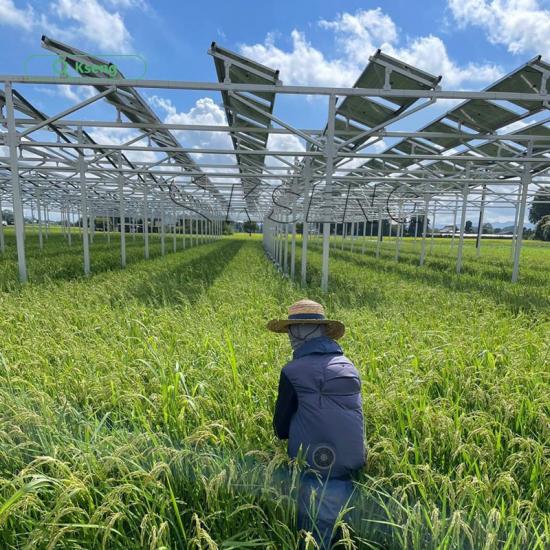 Selecting suitable materials, optimizing support spacing, and designing reliable connections help improve structural stability and long-term durability.
4. Corrosion Resistance and Material Selection
Agricultural environments can expose solar mounting structures to moisture, fertilizers, soil chemicals, and other corrosive conditions. Material selection and surface protection are therefore essential for maintaining structural performance.
Galvanized steel, Zn-Al-Mg coated steel, and aluminum are commonly used in solar mounting applications. The appropriate choice depends on environmental exposure, structural requirements, service life expectations, and project budget.
5. Solar Panel Layout and Sunlight Exposure
Solar panel spacing, tilt angle, and row orientation influence energy generation and land utilization. Poorly planned layouts may cause excessive shading, reduce agricultural working space, or interfere with machinery access.
For agrivoltaic projects, the mounting structure should be designed to balance solar energy production with crop growth requirements. Crop type, sunlight needs, and local climate should all be considered during system planning.
6. Agricultural Machinery Access and Land Management
Agricultural solar mounting systems should accommodate the movement of tractors, harvesters, and other farming equipment where required. Support columns, foundation positions, and row spacing should be arranged to minimize interference with daily agricultural operations.
Selecting suitable materials, optimizing support spacing, and designing reliable connections help improve structural stability and long-term durability.
4. Corrosion Resistance and Material Selection
Agricultural environments can expose solar mounting structures to moisture, fertilizers, soil chemicals, and other corrosive conditions. Material selection and surface protection are therefore essential for maintaining structural performance.
Galvanized steel, Zn-Al-Mg coated steel, and aluminum are commonly used in solar mounting applications. The appropriate choice depends on environmental exposure, structural requirements, service life expectations, and project budget.
5. Solar Panel Layout and Sunlight Exposure
Solar panel spacing, tilt angle, and row orientation influence energy generation and land utilization. Poorly planned layouts may cause excessive shading, reduce agricultural working space, or interfere with machinery access.
For agrivoltaic projects, the mounting structure should be designed to balance solar energy production with crop growth requirements. Crop type, sunlight needs, and local climate should all be considered during system planning.
6. Agricultural Machinery Access and Land Management
Agricultural solar mounting systems should accommodate the movement of tractors, harvesters, and other farming equipment where required. Support columns, foundation positions, and row spacing should be arranged to minimize interference with daily agricultural operations.
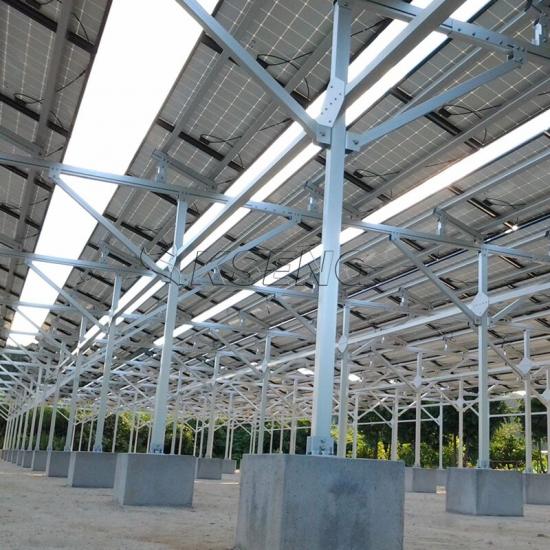 Careful layout planning can help reduce obstacles, maintain practical access routes, and support more efficient land management.
7. Installation Efficiency and Maintenance
A practical solar mounting system design can simplify transportation, assembly, inspection, and maintenance. Standardized components and well-planned connections may help reduce installation complexity and improve construction efficiency.
Designers should also consider access to structural components, drainage conditions, and vegetation management to support reliable long-term operation.
Conclusion
Designing solar mounting systems for agricultural land requires a balance between structural reliability, solar energy generation, and agricultural usability. Soil conditions, mounting height, material durability, panel layout, and machinery access all influence system performance.
By evaluating these factors during the planning stage, project developers can select suitable ground-mounted solar structures for farmland and agrivoltaic applications.
Careful layout planning can help reduce obstacles, maintain practical access routes, and support more efficient land management.
7. Installation Efficiency and Maintenance
A practical solar mounting system design can simplify transportation, assembly, inspection, and maintenance. Standardized components and well-planned connections may help reduce installation complexity and improve construction efficiency.
Designers should also consider access to structural components, drainage conditions, and vegetation management to support reliable long-term operation.
Conclusion
Designing solar mounting systems for agricultural land requires a balance between structural reliability, solar energy generation, and agricultural usability. Soil conditions, mounting height, material durability, panel layout, and machinery access all influence system performance.
By evaluating these factors during the planning stage, project developers can select suitable ground-mounted solar structures for farmland and agrivoltaic applications.
Choosing a reliable solar mounting system manufacturer with relevant engineering experience can also help ensure that the mounting solution meets project requirements and supports long-term photovoltaic performance.
FAQs
1. What is an agricultural solar mounting system?
An agricultural solar mounting system is a structural solution designed to support PV modules on farmland while accommodating agricultural activities such as crop cultivation, livestock grazing, and machinery access.
2. What factors affect the design of solar mounting systems on agricultural land?
Key factors include soil conditions, wind and snow loads, mounting height, foundation type, PV module layout, corrosion resistance, and the agricultural activities planned for the site.
3. Which materials are commonly used for agricultural solar mounting structures?
Galvanized steel, Zn-Al-Mg coated steel, and aluminum are commonly used. Material selection depends on structural requirements, environmental exposure, corrosion resistance, and project budget.
4. How does mounting height affect agricultural solar projects?
Mounting height determines the available clearance beneath solar panels, influencing machinery access, livestock movement, and crop cultivation. The appropriate height depends on the intended agricultural activities and structural design requirements.
5. What challenges should be considered when designing agrivoltaic mounting systems?
Agrivoltaic projects must balance solar energy production with agricultural requirements. Important considerations include sunlight distribution, crop growth conditions, panel spacing, mounting height, soil protection, and access for farm equipment.



 Soporta red IPv6